Outdoor play is more than using up energy
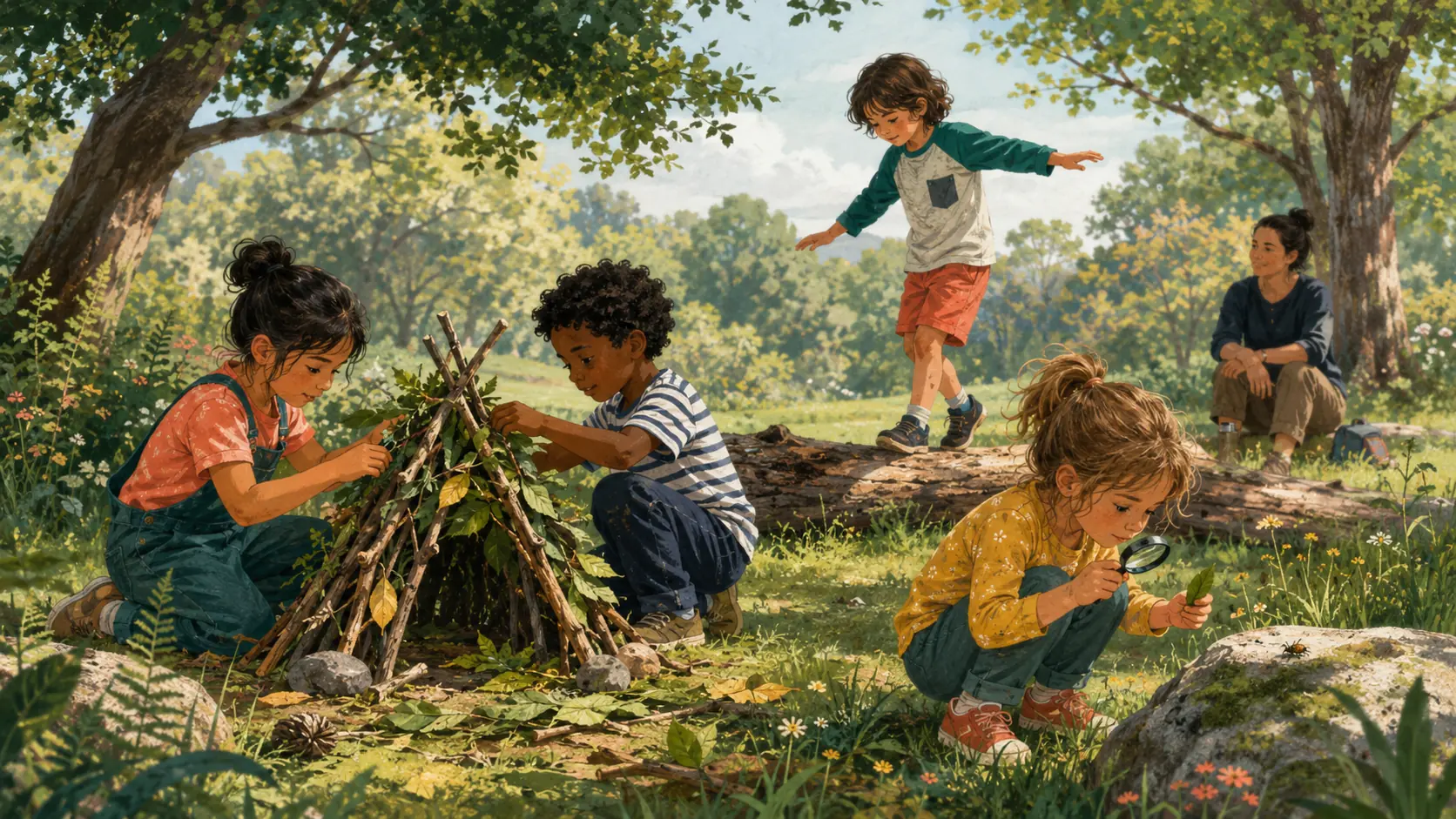
A courtyard, park or natural area offers surfaces, distances, sounds and materials that are not fully defined in advance. A branch can become a tool or part of a construction, while a slope invites children to adjust balance and speed.
Movement matters, but so do choice, imagination, shared rule-making, observation and repeated attempts.
Outdoor play does not require a perfect activity—only time, a possible place and room for children to decide.
What the available research shows
Outdoor-play studies use different ages, settings and methods, so findings should be described as trends and associations rather than automatic promises. One systematic review found generally positive relationships between outdoor time, physical activity and some fitness indicators, while warning that causality could not always be established.
A review of unstructured nature play reported consistent positive outcomes for physical activity and cognitive play behaviours, including imaginative and dramatic play, while also identifying limitations in the evidence base.
Movement, creativity and social play
Outdoor spaces often allow larger movements, varied speeds, jumping, pulling and balancing. These actions arise within the purpose of play rather than as a list of adult-led exercises.
Soil, water, stones, leaves and branches have no single correct use. They invite construction, classification, stories and problem-solving, while shared play involves negotiating turns, rules and meanings.
Autonomy and manageable challenge
A visible challenge is not the same as a hidden hazard. Balancing on a low log or choosing where to step allows children to notice limits and adjust their actions.
A systematic review found positive associations between risky outdoor play, physical activity and social health, but rated the evidence from very low to moderate. The practical lesson is to distinguish challenges children can assess from hazards adults need to remove.
The adult’s role
Adults inspect the setting, remove traffic, broken glass or other hazards children cannot anticipate, agree clear boundaries and remain available without stepping into every decision.
Observation can come before solutions: what are you trying, what would make it more stable, and how will you know it is safe? Support increases with age, context and individual need.
In practice, this support begins with choosing a permitted, visible setting that suits the group’s age. Before play starts, adults can also consider shade, drinking water, weather, sun protection and suitable clothing, while checking accessibility and providing different ways for every child to participate.
Boundaries work best when they are simple and easy to understand. This allows adults to observe and listen closely, offer help when a challenge exceeds a child’s current capabilities and avoid turning play into a sequence of instructions.
Creating more opportunities
Families and communities do not have equal access to safe parks, courtyards, time or green space. A review of 107 studies showed that outdoor play is shaped by individual, family, social, environmental and seasonal factors, so it should not be framed only as a personal choice.
Schools, councils, communities and families can protect playtime, improve nearby settings and offer simple loose materials. Even a small courtyard or community space can support outdoor play when children may transform it.
A realistic way to create more opportunities is to protect regular periods of time without a productive goal or competition. Age-appropriate boxes, fabric, containers, short ropes and natural loose parts can enrich the setting and inspire constructions, pathways, stories and new questions.
Free exploration can be accompanied by occasional observation questions, as long as they do not interrupt children’s initiative. When a construction or investigation remains unfinished, allowing it to continue another day shows that the process matters more than reaching a finished result quickly.