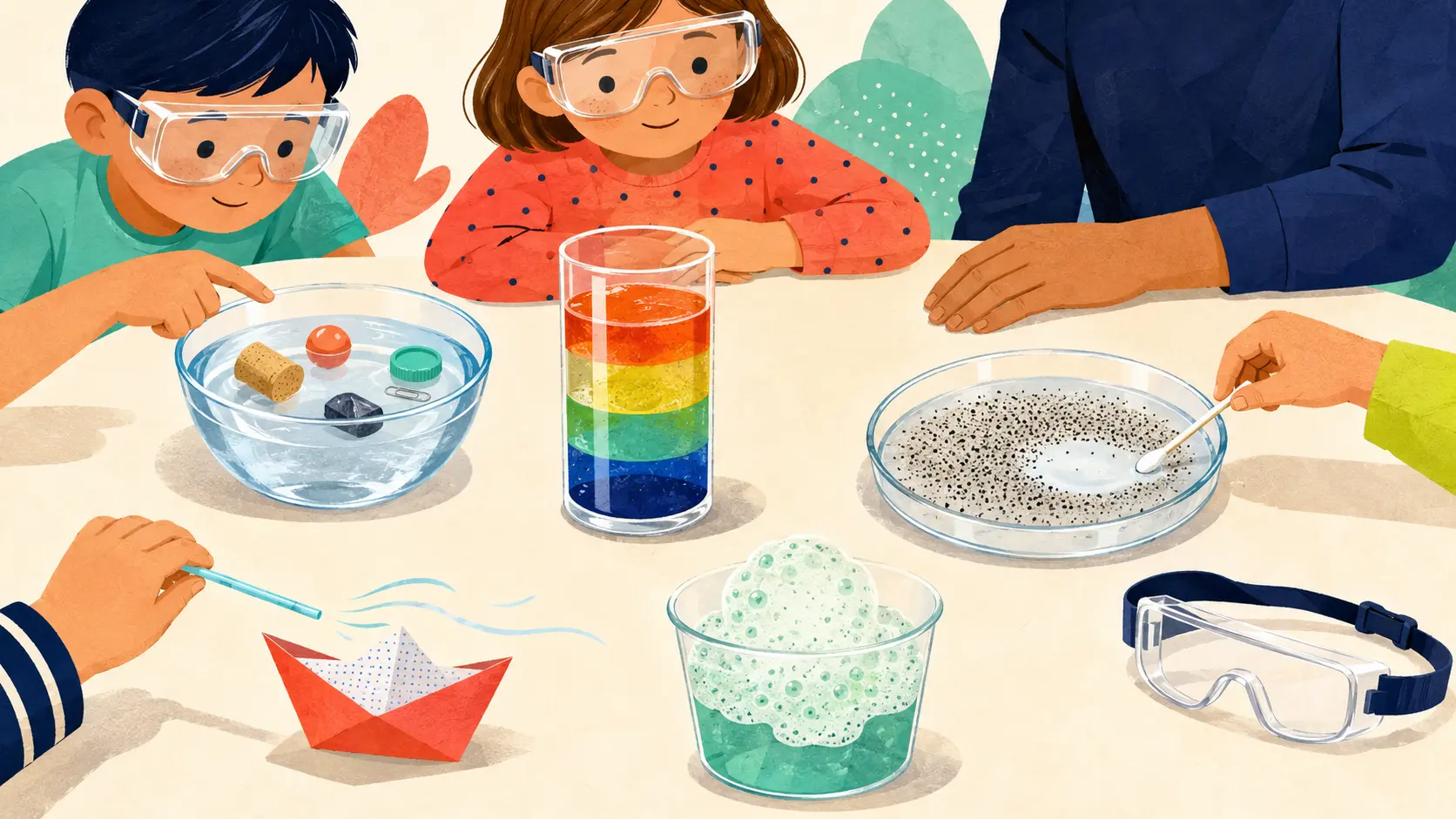
Prepare a safe environment
Science with children requires a clear table, labelled materials, short instructions and continuous adult supervision. Keep quantities small and make it clear that none of the materials are food.
Protect the surface, tie back long hair, check sensitivities and use goggles where splashes are possible. Never mix cleaning products or seal a reaction that releases gas.
These low-risk educational ideas still require the judgement and supervision of a responsible adult.
1. Will it float or sink?
Place clean objects made from different materials beside a transparent tub of water. Ask for predictions before testing one object at a time.
Change aluminium foil from a compact ball into a small boat and compare. This opens discussion about density, shape and displaced water.
- Guiding question: does weight alone predict the result?
- Avoid sharp, rusty or age-inappropriate small objects.
2. A liquid tower
Slowly layer syrup, coloured water and oil in a tall clear glass. The liquids settle according to density and how readily they mix.
Drop one light and one denser object, then describe where each stops. Dispose of the mixture; do not drink it.
- Guiding question: why do the layers keep this order?
3. Pepper moves away from soap
Sprinkle a small amount of pepper on water in a plate, then touch the centre with a cotton bud holding one drop of dish soap. The pepper moves as the water’s surface tension changes.
Compare with a clean cotton bud and identify the single variable that changed.
- Keep soap away from eyes and wash hands afterwards.
4. Motion powered by air
Use a straw or manual air blower to move a paper ball along a smooth track. Compare gentle and stronger airflow or different directions.
Give each participant a separate straw and avoid small pieces with children who may put them in their mouths.
- Guiding question: what changes when air arrives from the side?
5. An open baking-soda reaction
Place a teaspoon of baking soda in an open tray or cup and slowly add a small amount of vinegar. The bubbles are carbon dioxide produced by the reaction.
Change only one quantity in a second trial and compare duration or foam height. Never seal the reaction or lean over the container.
- Work on a tray and use goggles where splashing is possible.
Turn the effect into learning
Ask what changed, what stayed the same and what evidence supports the explanation. Drawing before and after or recording a prediction helps move beyond surprise.
An unexpected result is useful information: review quantities, steps and conditions instead of treating it as failure.