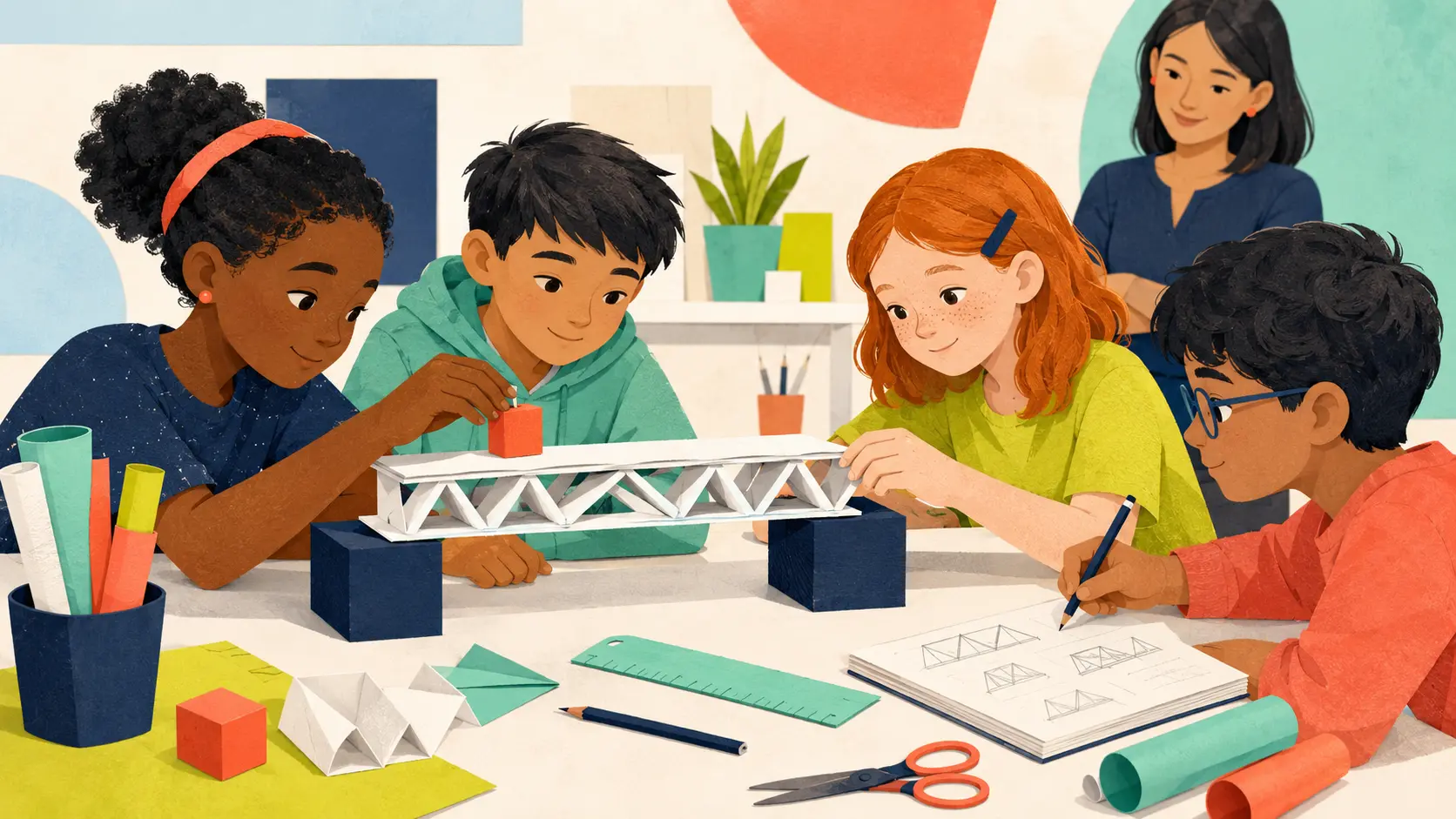
STEM connects learning areas
STEM brings together science, technology, engineering and mathematics. Its value lies in using those areas together to understand a situation or solve a meaningful challenge.
Students observe, gather information, propose a solution, build a model and review what happened. Each discipline appears because it helps the group move forward.
An activity becomes STEM through connected questions, decisions, evidence and improvement—not simply through the use of technology.
Example: a paper bridge
Challenge teams to use two sheets of paper to span 20 centimetres and hold as many coins as possible. They observe forms, sketch an idea and agree how results will be measured.
Science supports material observations; mathematics supports measurement; engineering shapes design; and technology includes the tools and procedures used for a purpose. Teams change one feature after the first trial.
Five moments in a STEM experience
A simple sequence keeps the investigation focused without prescribing one correct solution.
- Present a clear, relevant challenge.
- Explore materials and initial ideas.
- Represent a design before building.
- Test against an observable criterion and record data.
- Modify, retest and communicate learning.
The adult’s role
The facilitator defines the problem, protects safety and asks questions instead of immediately giving the solution: what data do you need, how will you know it improved and what will you change?
Errors become information. A failed bridge can reveal deformation, load paths and useful next steps.
STEM with accessible resources
Robots and expensive laboratories are not essential. Cardboard, paper, rubber bands, containers and reusable elements can support challenges involving structures, energy, mixtures or movement.
What matters is a question with several possible solutions, a comparison criterion and enough time for more than one attempt.
Observe the process, not only the product
Look for justified decisions, useful records, listening and evidence-based changes. A photo, a short table and an oral explanation can document learning.
A well-designed STEM experience leaves a transferable idea: complex problems can be divided, tested and improved collaboratively.