Curiosity needs room to act
Materials, a mission and time to explore let children ask questions before receiving a full explanation. This autonomy reveals what they know, imagine and want to test.
Play lowers the fear of being wrong. In science, a prediction that does not match the result invites closer observation and a revised idea.
Free play and guided play
In free play, participants largely shape the goal and rules. In guided play, an adult prepares the setting and offers a broad mission while leaving decisions open.
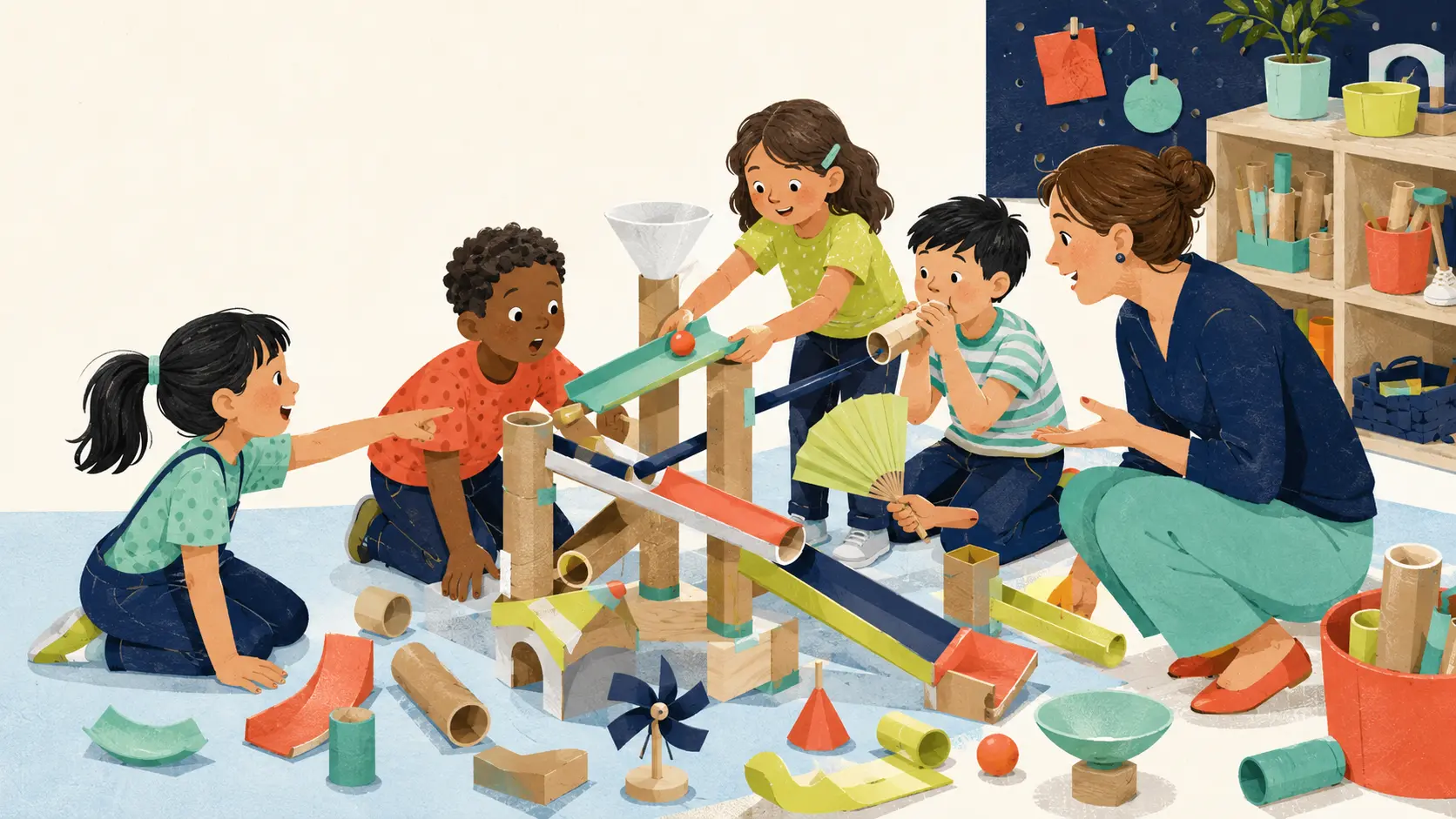
A group might be challenged to move a ball without touching it, using cardboard, tubes and air. The adult provides safe materials and boundaries, not a finished model.
The mission provides direction; children’s decisions keep the play alive.
Four questions that support inquiry
Adults can guide without turning every attempt into a test.
- Prediction: what do you think will happen if we change this?
- Observation: what did you see, hear or feel?
- Comparison: what differed between the first and second attempt?
- Next step: what could you test now?
Adapt the challenge to age
Young children benefit from visible actions, few rules and short cycles. Older groups can add measurement, records and design restrictions.
The difficulty should allow progress without making the answer immediate. Model one action if nobody can begin; add a condition if every solution appears at once.
Observe without interrupting
Record phrases, strategies and changes of mind rather than correcting every response. Photographing a model or asking for a drawing can preserve useful evidence.
Value observation, explanation, listening and renewed attempts—not simply the fastest answer.
Close with one reusable idea
Gather two or three observations: what was tried, what changed and what question remains. Then introduce the scientific explanation in age-appropriate language.
The play keeps its energy while leaving an idea that can reappear at home, outside or in the classroom.